
The short answer: yes, absolutely—perhaps one of the best months. But not without a few notes. Let us break it down one by one, not just “because it’s the dry season”.
Weather: Dry, But Not Entirely Rain-Free
September in Mbuang-Mbuang Village has a fairly friendly weather profile. Climate data from timeanddate.com shows average rainfall in September around 88.3 mm—much lower than May (218.6 mm) or June (211.2 mm). The average temperature hovers around 26°C, with highs around 31°C and lows of 22°C. Humidity is also relatively lower, around 74%.
Important note: this data comes from the Kendari / Woltermon-Ginsidi weather station located about 277 km from Mbuang-Mbuang Village, so actual local conditions may vary slightly.
These numbers matter because Mbuang-Mbuang is not an easily accessible destination. Traveling there depends heavily on sea conditions. A travel guide notes that the dry season from May to October is the best time to visit Banggai, as the sea is calmer and the sky clearer—ideal for snorkeling, hiking, and island hopping.
September sits towards the end of the dry season. This means the sea tends to be calmer compared to the early months of the year, but has not yet fully entered the rainy period that can make sea travel more challenging.
Jellyfish Lake: Actually More Alive During the Rain?
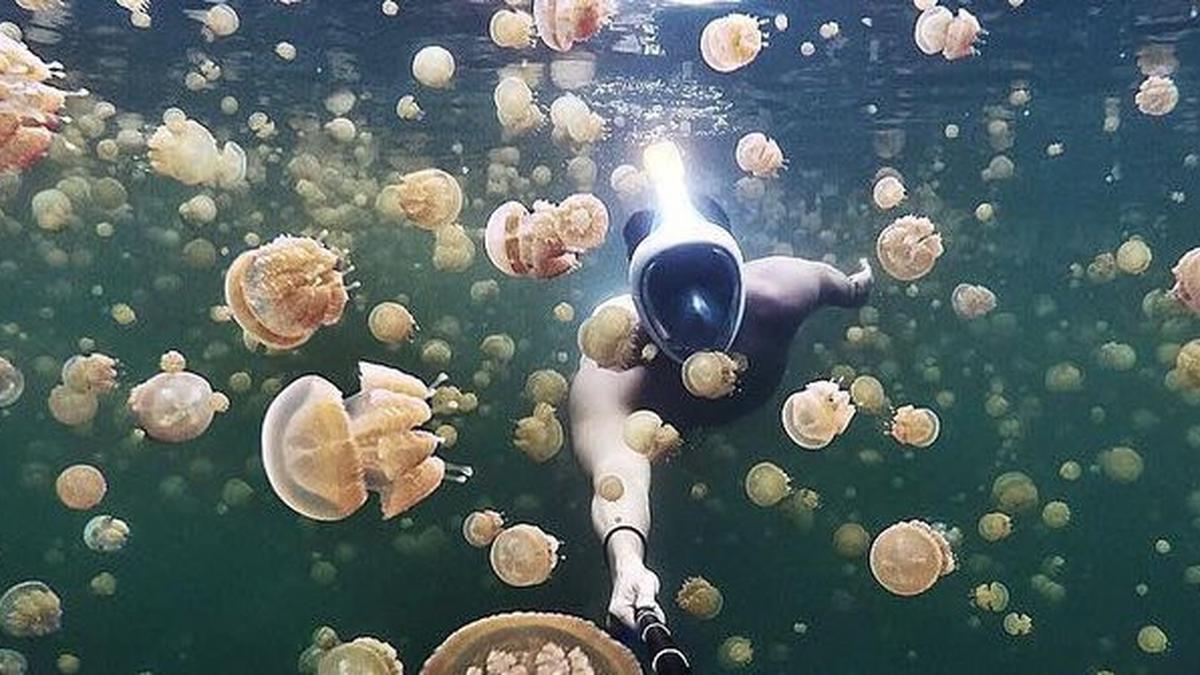
This part is somewhat paradoxical. Many sources mention that during the rainy season, thousands of stingless jellyfish in Lake Paisu Batongan can cover much of the lake’s surface down to a depth of 12 meters. Some articles even state that this phenomenon occurs “when the rainy season arrives”.
So, does September—which is still considered dry—mean fewer jellyfish?
Not necessarily. The jellyfish in Lake Paisu Batongan are permanent residents of this saltwater lake. They can be seen from above the surface, and during the morning to midday, their numbers are clearly visible. What might change is their visual density at the surface—during rains, currents and water conditions may differ, making jellyfish appear to congregate more heavily on the surface.
Thus, September still gives you the opportunity to swim with these gentle jellyfish. The rule: do not wear sunscreen or swimming aids such as fins, as they will harm their ecosystem.
Access: An Unchanging Challenge
One thing you need to realize: September does not change the fact that Mbuang-Mbuang is extremely remote. This village is located on Salue Kecil Island, Bokan Kepulauan District, Banggai Laut Regency, Central Sulawesi—the easternmost village in central Indonesia.
To get there, you have two main options:
- Regular boat: about 7 hours from the capital of Banggai Laut Regency, costing around IDR 55,000 per person (departs in the morning around 10 AM). This boat stops at several villages before finally arriving at Mbuang-Mbuang as the last stop.
- Speedboat: about 2 hours, costing around IDR 2 million per round trip for a capacity of 5–8 people.
In the village itself, mobile signal is very limited. You have to take a boat to Pingo Beach (about 15 minutes) to catch a signal, and even then, only for one provider. Electricity also only runs from around 6:00 PM to 10:00 PM. This is not a destination for those who need a stable connection.
What Can You Do in September?
Besides Lake Paisu Batongan, there are many other spots: Kima Marine Park (giant clam conservation), Pasir Panjang Beach, Popisi Hill (a view often compared to Raja Ampat), Pangaan Cave, as well as various small islands such as Palanggang Island (some sources refer to it as Palanggang Beach, while the official Tourism Village list records it as Palanggang Island), Sidu Island, Toado Island, and Karang Timbul Tanalan.
September also grants the bonus of clearer skies for snorkeling and diving. Banggai waters are known for high biodiversity, including the endemic species Banggai Cardinalfish (Pterapogon kauderni), found only in the Banggai Archipelago.
If you happen to be there on September 7–8, 2025, there is a celestial phenomenon not to be missed: a total lunar eclipse will be visible from Mbuang-Mbuang Village. The eclipse lasts from 11:27 PM WIB to 2:56 AM WIB (Jakarta time), which means in WITA (Mbuang-Mbuang time) it takes place in the early morning of September 8, around 12:27 AM–3:56 AM WITA. The total phase occurs around 1:30 AM–2:54 AM WITA.
This is a rare moment—swimming with jellyfish by day, then watching a total lunar eclipse in the early hours of the morning.
So, Is September the Right Time?
Yes, with a few notes:
- Weather: Low rainfall (88.3 mm), comfortable temperature (26°C average), relatively calm seas. This is one of the best windows before the rainy season truly arrives. Note: data from the Kendari station (±277 km), may vary slightly on site.
- Jellyfish: Can still be enjoyed, especially during the morning to midday. Visual density may not be as dramatic as during the peak of the rainy season.
- Access: Logistic challenges remain the same. Regular boat 7 hours (IDR 55,000) or speedboat 2 hours (around IDR 2 million). Prepare extra time, energy, and patience.
- Facilities: Limited electricity (6:00 PM–10:00 PM), minimal signal. This is part of the charm—or the test—depending on how you look at it.
Mbuang-Mbuang is not a destination for everyone. But if you are looking for a place truly far from the crowds, where you can swim with jellyfish that have forgotten how to sting, and enjoy white sand beaches almost untouched by commercialism—September is the right gateway.