
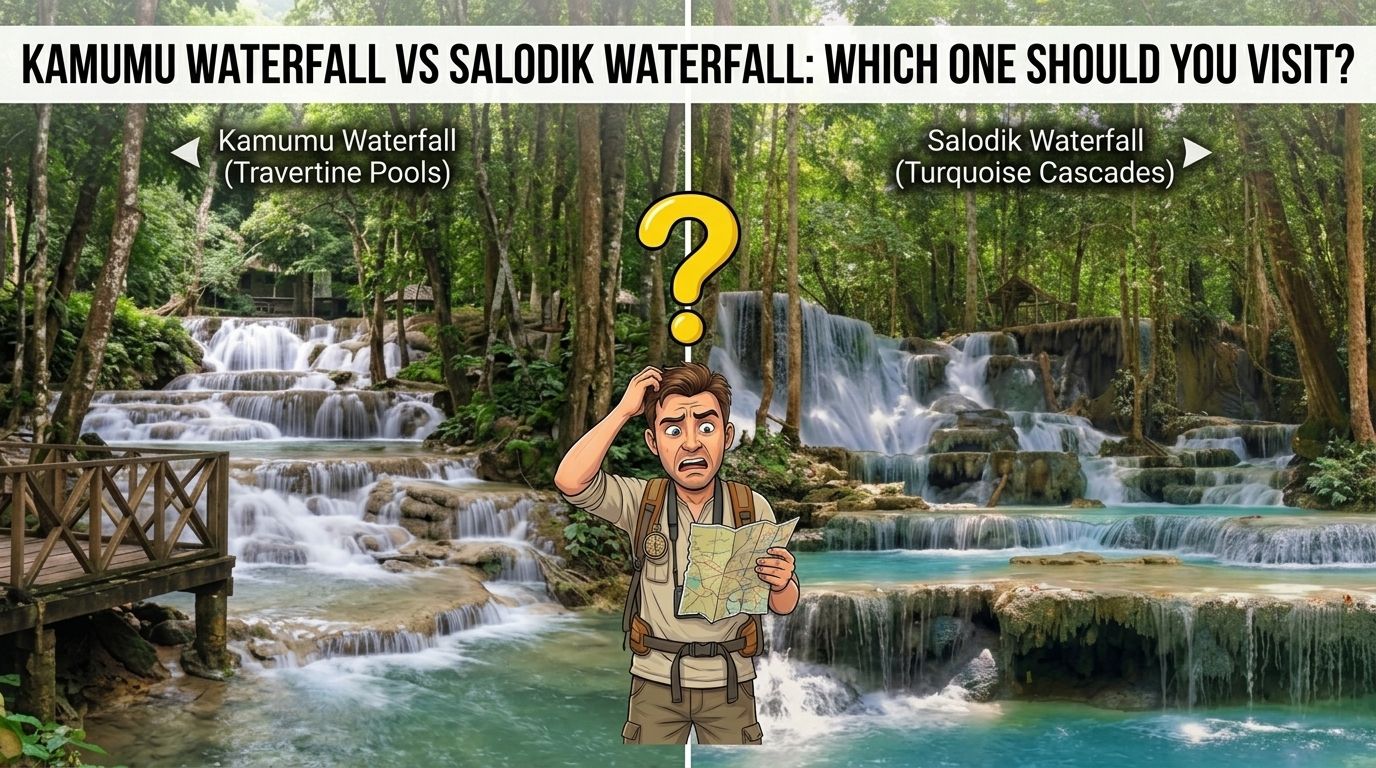
Luwuk and its surroundings are home to many waterfalls, but the two names that come up most often in travelers’ conversations are Kamumu Waterfall and Salodik Waterfall. Both are located in North Luwuk District, only a few kilometers from each other, and both offer clear, multi-tiered flows of water. However, the experience at each place can feel very different, depending on what you are looking for.
This article compares the two directly—from access, facilities, and atmosphere to who is best suited to visit each one. Neither is truly “better” than the other; the better choice is simply the one that best suits your preferences.
A Quick Comparison
| Aspect | Kamumu Waterfall | Salodik Waterfall |
|---|---|---|
| Location | Kamumu Village, North Luwuk | Salodik Village, North Luwuk |
| Distance from Luwuk | ±26 km, 30–45 minutes | ±20 km, ±1 hour |
| Access from the main road | Requires a 15–20-minute trek | Directly beside the Trans-Sulawesi Highway |
| Entrance fee | ±Rp5,000 (local), ±Rp15,000 (international) | ±Rp2,000–Rp10,000 |
| Natural character | Pine forest, wild atmosphere | Tropical forest, landscaped area |
| Facilities | Very limited | More complete (toilets, gazebos, parking) |
| Crowd level | Quieter | More popular |
| Best suited for | Adventurers, those seeking tranquility | Families, short visits |
Location and Access
Both are located in North Luwuk District, but their access characteristics are different.
Salodik Waterfall is located directly beside the Trans-Sulawesi Highway, the main route connecting Luwuk with Pagimana. This is its greatest advantage: you can park your vehicle, walk a few steps, and arrive. There is no significant trekking involved. From central Luwuk, it is approximately 20 kilometers away, with a travel time of around one hour because of the winding, uphill route.
Kamumu Waterfall, by contrast, requires a little more effort. From central Luwuk, the overland journey takes 30–45 minutes to Kamumu Village. After arriving at the village parking area, you still have to walk for approximately 15–20 minutes through local residents’ coconut and clove plantations, then descend a footpath toward the waterfall. The route is relatively gentle, but it can be slippery after rain.
If you have limited time or do not want to walk far, Salodik is more practical. If you do not mind a short trek and want to experience a more “wild” atmosphere, Kamumu offers a more rewarding experience.
Natural Character and Atmosphere
This is the most noticeable difference.
Salodik is surrounded by lush tropical forest. Its water flows over neatly arranged rock terraces resembling natural steps, forming small bluish-green pools. The area is well organized, with walking paths, gazebos, and picnic areas. It is comfortable and easy to enjoy, but it also feels more like a managed “tourist attraction.”
Kamumu feels more untouched. What sets it apart is the pine forest surrounding the waterfall—a sight rarely found at tropical waterfalls. Its water also flows in tiers, forming clear pools among the rocks. However, there are no buildings, no large signs, and no excessive infrastructure. It is simply nature left as it is. Some visitors describe it as a place “hidden in the middle of nature,” with a peaceful atmosphere that is not yet too crowded.
If you are looking for tranquility and a more natural atmosphere, Kamumu has the edge. If you prefer a well-organized and easily accessible place, Salodik is more comfortable.
Facilities
Here, Salodik is clearly superior.
Salodik has adequate facilities: a parking area, toilets, walking paths, gazebos, and a tourist bridge. All transactions are made in cash on-site, so be sure to bring small denominations.
Kamumu has very few facilities. There are no toilets, no changing rooms, and no food vendors around the waterfall. Visitors must bring their own supplies and take responsibility for their own rubbish. There is a parking area managed by village residents, but otherwise you need to be self-sufficient.
If you are bringing children, elderly people, or family members who need basic facilities, Salodik is more family-friendly. If you do not mind bringing provisions and taking care of your own needs, Kamumu offers greater freedom.
Entrance Fees
Both are very affordable, but there is a difference in price.
Salodik charges an entrance fee of around Rp2,000 to Rp10,000 per person, depending on the source and time of visit. Some reports mention Rp2,000, while others state Rp10,000. This price makes it one of the most budget-friendly natural attractions in Central Sulawesi.
Kamumu charges approximately Rp5,000 for local tourists and Rp15,000 for international tourists. Different rates for foreign visitors are common practice at some destinations in Indonesia.
The price difference is not significant. More important is the transportation cost: if you hire a vehicle with a driver, the trip to Kamumu may be slightly more expensive because it is farther away and takes longer to reach.
Best Time to Visit
Both can be visited year-round, but their ideal conditions are slightly different.
Salodik can be enjoyed at any time. Because it is located beside the main road and its facilities are well organized, the rainy season is not too disruptive. However, as with waterfalls in general, the water flow can increase after rain.
Kamumu is more sensitive to weather conditions. The trek to the waterfall follows an earthen path that can become slippery after rain. The dry season (June–October) is the best time to visit, especially September and October, which are the driest months in Luwuk.
For both, morning (07:00–10:00 WITA) is the best time: the air is still cool, the light is good for photography, and there are still few visitors. Avoid weekends and national holidays if you want a quieter atmosphere.
The Experiences on Offer
Salodik is ideal for a short visit. You can arrive, take photos, take a quick dip, and leave. No significant physical preparation is needed. The place is also a popular photo spot because of its photogenic tiered structure.
Kamumu offers a more “adventurous” experience. Trekking through residents’ plantations, descending a footpath, and arriving at a waterfall hidden in the middle of a pine forest creates a sense of achievement. Some visitors report that their fatigue from the trek disappears as soon as they enjoy the cool, refreshing pools.
If you simply want to relax and enjoy the scenery without moving around much, Salodik is more suitable. If you want to experience a little challenge and “discover” a place that feels more hidden, Kamumu offers a different kind of satisfaction.
Which One Should You Choose?
Choose Salodik Waterfall if:
- You have limited time or are on your way to another destination
- You are bringing children, elderly people, or family members who need basic facilities
- You want a place that is easy to access without trekking
- You prefer a well-organized atmosphere and do not want to bring much equipment
Choose Kamumu Waterfall if:
- You do not mind a short 15–20-minute trek
- You are looking for a quieter, more natural atmosphere
- You are interested in the unusual scenery of a pine forest
- You want a more “adventurous” and independent experience
- You have already visited Salodik and want to try something different
Can You Visit Both in One Day?
Yes. Both are located in North Luwuk District and are not very far from each other. If you hire a vehicle with a driver, you can visit Salodik first—because it is easy to access and does not require much time—then continue to Kamumu for trekking and a longer period of relaxation.
However, keep in mind that the two have different characters. Salodik is better suited to a short visit, while Kamumu requires at least 2–3 hours, including trekking. If you want to enjoy both without rushing, set aside half a day to a full day.
Conclusion
Kamumu Waterfall and Salodik Waterfall are not rivals; they are two different experiences of the same Banggai natural environment. Salodik offers comfort and accessibility, while Kamumu offers tranquility and a small adventure. The best approach is to match your choice to your time, physical condition, and preferences—rather than looking for which one is absolutely “better.”
If you are still unsure, consider this: Salodik is the place you visit when you want to relax without making an effort. Kamumu is the place you visit when you want to feel that you have truly “gone” somewhere. Both are worthwhile, and both will give you a different story.
If you would like to explore Kamumu Waterfall, Salodik, and other destinations around Luwuk with a customized itinerary, Banggai Wonderland can help arrange a private trip based on your time, interests, and travel style.
WhatsApp: 085820830530 Instagram: @banggaiwonderland
Frequently Asked Questions
Which is easier to access, Kamumu or Salodik?
Salodik is easier to access because it is located directly beside the Trans-Sulawesi Highway. You can park your vehicle and walk a few steps. Kamumu requires a 15–20-minute trek from the village parking area.
Which is more crowded, Kamumu Waterfall or Salodik?
Salodik is more popular and more crowded, especially on weekends and holidays. Kamumu tends to be quieter because it requires trekking to reach and has more limited facilities.
How much are the entrance fees for Kamumu Waterfall and Salodik?
Kamumu costs approximately Rp5,000 for local tourists and Rp15,000 for international visitors. Salodik costs approximately Rp2,000 to Rp10,000, depending on the source and time of visit.
Is Salodik suitable for children and elderly people?
Yes. Salodik has more complete facilities (toilets, walking paths, and gazebos) and is easy to access. Kamumu is less suitable for children or elderly people because of the descending trekking route and limited facilities.
Which is better for photography?
Both are good. Salodik has neat, photogenic tiered formations. Kamumu offers a unique pine-forest backdrop and a more natural atmosphere. The best time for both is morning or afternoon.
Can you visit Kamumu and Salodik in one day?
Yes. Both are located in North Luwuk District and are not very far from each other. Salodik can be visited first because it is quick to access, followed by Kamumu for trekking and relaxation.