
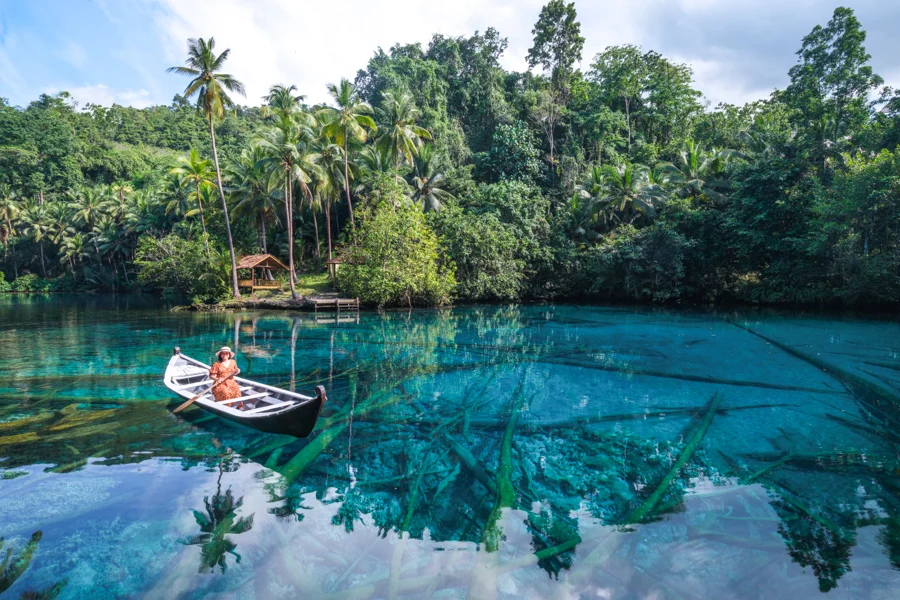
Most Banggai trip plans are really Peleng trip plans. Paisu Pok Lake, Poganda Beach, Mandel Beach and the caves of the south are all on the same island, yet many visitors know Peleng only as a line on a ferry ticket. This overview explains what the island is, what is special about its nature and how to think about it before you book.
The island at a glance
Peleng (also spelled Peling) is the largest island of the Banggai Islands, in Central Sulawesi, lying across the water from the Luwuk peninsula. Reference sources give its area as about 2,489 square kilometers and its population as roughly 131,700 as of mid-2021. The interior rises to around 1,100 meters. The island is part of Banggai Islands Regency, and the town of Salakan is its main hub; our Luwuk to Salakan package uses it as a base.
The island is large enough that distances matter. A place that looks close on a map may involve a long, slow road, so plan by travel time and not by kilometers.
A landscape shaped by limestone
Peleng sits within an archipelago described by researchers as largely karst, which helps explain the lakes, springs and caves you see across the island. Our article on the karst landscape of the Banggai Islands explains how this works and what the numbers say.
Wildlife worth knowing
Islands that are separated from their neighbors for long periods often develop distinctive animals, and Peleng is an example. A 2020 study published in the journal Science reported new bird taxa from Peleng and nearby islands in Indonesia’s Wallacea region, including a species named the Peleng fantail (Rhipidura habibiei). We cite this as a sign of how much remains to be documented here, not as a promise that you will see any particular bird on a short visit. Birdwatching needs early mornings, patience and a guide with local knowledge of habitat.
On the water, the Banggai cardinalfish is the marine species most associated with the archipelago. Our cardinalfish guide explains how to watch it without disturbing it.
Main places to visit
- Paisu Pok Lake. The headline stop, near Luk Panenteng, with clear turquoise water. See the complete travel guide.
- Paisu Batango. A coastal spring pool in the same village area, shaped by the tides.
- Poganda Beach. A quiet beach in Luk Panenteng, easily combined with the lake.
- Mandel Beach. A beach on Peleng reached from the ferry side of the island.
- Goa Babanang and the south. A cave in Babang, Bulagi Selatan, with other sites described in our southern Peleng route guide.
Getting there and moving around
The usual route is by sea from Luwuk. A public ferry to Leme-Leme and a private speedboat are the two options described in our guide to reaching the Banggai Islands from Luwuk. From Leme-Leme, the road to the Paisu Pok area takes around an hour in normal conditions, according to current travel information, and road quality can drop after rain.
Facilities are simple outside the main towns. Homestays in Luk Panenteng are the practical base for the lake area. Carry cash, water and insect repellent. A traveler report from 2025 advises malaria precautions in parts of Sulawesi; speak to a doctor or travel clinic about your own situation, as we cannot give medical advice.
How long to stay
One night on Peleng is the minimum if Paisu Pok is your goal, since arrival and departure days are mostly spent in transit. Two or three nights allow you to add beaches or the south without rushing. Our 4-day itinerary shows one way to do it, and the duration guide compares different lengths.
Plan your Peleng trip
Banggai Wonderland organizes private trips from Luwuk with local guides and a relaxed pace. Explore Banggai with us through our tour service or contact Banggai Wonderland on WhatsApp to build a route around the places above.
Sources
- Wikipedia, “Peleng Island” (area, population, elevation, bird discovery), accessed for this article.
- Science (2020), study on new bird taxa in Indonesia’s Wallacea region, as summarized in reference sources.
- Banggai Wonderland destination pages and route guides.
- A 2025 independent travel report on Banggai and Paisu Pok, as cited on this site.