
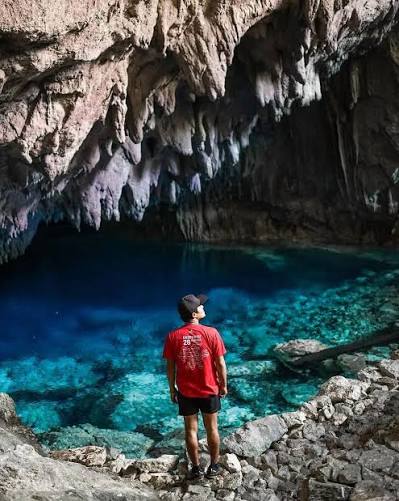
Travelers to the Banggai Islands often describe the same thing: water that is startlingly clear, in lakes, in pools beside the sea and in rivers. The reason is not a coincidence of scenery. Large parts of the archipelago are made of limestone, and limestone behaves very differently from the volcanic or clay soils found in much of Indonesia. Knowing a little about it makes a Banggai trip more interesting and helps you visit sensibly.
What karst is, in plain terms
Karst is a landscape formed when slightly acidic rainwater slowly dissolves limestone. Over thousands of years the rock develops cracks, tunnels, caves and sinkholes. Rain does not run across the surface for long; it drains underground, travels through the rock and comes out again as springs. Because the water is filtered through stone and carries little silt, it often looks clear and blue-green where it surfaces.
This is a general explanation of how karst works. It is consistent with what visitors see at places such as Paisu Pok Lake, but we are not citing a laboratory study of each individual site.
What researchers have counted
Figures for Banggai karst come from several sources and they do not match exactly, so it helps to see them as indications rather than a final inventory.
- Researchers from Universitas Gadjah Mada and Indonesia’s national research agency (BRIN), cited in Indonesian reports, describe the archipelago as largely karst. One figure puts it at about 85 percent. The same data lists 17 caves, 7 karst lakes (including 2 high-altitude lakes affected by tides but holding fresh water), 112 springs and 3 vertical sinkholes of the cenote type. A deep shaft known as Sumur O’ang is among them. Banggai Laut is described as very little explored.
- A January 2024 report in Mongabay cites a different count: 124 springs, one underground river, 17 caves, 103 rivers and 5 lakes.
Differences like 112 versus 124 springs usually come from survey dates and definitions, not from an error by either side. What is consistent is the overall picture: caves, springs and lakes are an important part of the islands’ identity.
Where you can see karst on a trip
- Paisu Pok Lake. The best known stop on Peleng, with turquoise water and submerged trees. Read the complete travel guide and what to know before visiting.
- Paisu Batango. A coastal spring pool near Luk Panenteng where fresh, brackish and sea water can meet depending on the tide. See the destination page. The pool is also a village water source, so treat it that way.
- Goa Babanang. A cave in Babang, southern Peleng. Our destination page and the southern Peleng route guide explain what is known about access.
- Goa Susundeng. Reported in the research coverage as the site of a cave dive in 2023. It is a specialist site and not a standard visitor stop.
Practical tips for visiting
- Go with a local guide to caves. Caves can be slippery, dark and unmarked, and water levels change. Do not enter flooded passages without proper training and equipment.
- Bring a headlamp, sturdy sandals or shoes and a dry bag. Phone torches are a poor substitute inside a cave.
- Watch the weather. Heavy rain can raise water in caves and springs and make roads and tracks difficult.
- Do not touch formations or write on walls. Cave features grow extremely slowly and cannot be repaired.
- Keep soap, sunscreen and rubbish out of springs and lakes. Water that drains through limestone has little natural filtering once pollutants are in it, and the same springs often supply nearby homes.
Water, mining and why it matters
The same limestone that creates attractive scenery also stores the water that villages rely on. Mongabay’s reporting describes concerns among researchers and residents about mining permits on parts of the islands (it cites about 29 permits covering roughly 3,175 hectares) and about water availability in some villages, including a reported cost of about IDR 400,000 per tank in Alul. We cannot verify these figures independently, and the situation may have changed since publication, but they are a reminder that clean water is a shared resource here and not just scenery. Using water sparingly in homestays and choosing operators who respect village rules is a small, practical way to support that.
Planning the visit
Karst sites are best combined into a relaxed route with time for weather and tides. Peleng works well for this: the 4-day Banggai Islands itinerary links Paisu Pok with nearby sites, and the best time to visit Paisu Pok explains seasonal conditions.
Banggai Wonderland runs private trips from Luwuk with local guides who know the access conditions. Explore Banggai with us through our tour service in Luwuk and Banggai or contact us on WhatsApp to plan a route around caves, lakes and springs.
Sources
- Reports on Universitas Gadjah Mada and BRIN karst research in the Banggai Islands (figures as reported; counts differ between sources).
- Mongabay, January 2024 report on karst, water and mining in the Banggai Islands.
- Banggai Wonderland destination pages for Paisu Pok, Paisu Batango and Goa Babanang.